Tuesday, February 1, 2011

Go Green and Eco Friendly -learning from - Village Life


Go Green and Eco Friendly -
learning from - Villages and Sthala Vriksha 


Long before modern man coined the word Ecology, this subject was well understood and regarded by all the Ancients in every society and tribe. 
The important role of Trees & Plants in the environmental balance and the vital food chain was clearly understood.Thus it was treated with reverence; this is amply seen in Temple trees called "Sthala Vrikshas"-as Nature and trees was actually worshipped with the Gods. This culture was also linked to the seasons and celebrated at Sankaranti -Pongal, Vasant Panchami, Shravan (Aadi), Margarish (Margazi) etc. 
The Rishis, saints, philosophers, teachers and Elders  explained this well. Rulers and administrators all  took it seriously and maintained this with  a  pride in planting shady trees and preserving them with a water supply from wells. Also in the building of  rest houses. 
From the Scholars to the  common, everyone understood the need for Trees and their care and preservation. 

Man needed Trees and so a "Vanamohotsava"  culture was nurtured down the ages.  
Later the eco sytem awareness including the term "Ecology' and to 'grow more trees' - a slogan  was realised in recent years.Today the UN has even declared 2011 as the year of Forests, to promote eco systems -conserve forest land and reduce global warming despite some opposition from selfish vested interests. However to nurture this we need more than slogans and Resolutions-
We need the support of all in Go GREEN & BE ECO FRIENDLY
This blog post looks at simple approaches of Faith in Villagers to Trees, Nature and Work with photographs taken at a few places in India.

Sri Ganapathy Temple & Sthala Vriksha , near Vellore -off Jamalapuram
Note the Lingas -- in foreground.
 

BELOW-
pic taken on 31st Jan 2011 at Jamalpuram, Vellore
Sri Muthu Mariamman Koil-Gram Devata
built 1975, by the Elango Ezzakiyam Manram (Elango Cultural Association)


BELOW:
At Shree Kanchi Kamakshi Temple -Bilwa Tree with fruit  tree -at rear entrance of temple-
 BELOW:
At Shree Kanchi Kamakshi Temple -Neem tree -at front side.
 BELOW--
At Kurukshetra Harayana,  during our Teerth Yatra in 2007
BELOW
Neem & Ashwattha Tree - Shree Ganapathy Temple, Greenways lane
BELOW
Vanni Tree (Indian Mesquite) at Marundeeswar Temple Chennai
 Vanni Tree, Sthala Vriksha at ShreeMarundeshwar Temple, Chennai


Below the Ashwattha Tree at Jogeshwari Temple- Mumbai.


The Pipal or Bodhi Tree "Ashwattha" also comes under the  Ficus group. Lower pic is from a Temple tree at Chennai Fort Museum


REG- Ashwatha tree significance-
Among trees, the Aswatha is the most important. In most of the places, a murthy of God is consecrated below the tree. In Kerala and Tamil Nadu, the family which plants the tree, does sacred thread ceremony to the tree and then conducts its marriage with the neem tree. Most of the serpent Temples in Kerala and Ganesa temples in Tamil Nadu are constructed below this tree. Women who are not able to beget children are asked to go round the tree daily.

The great shade of the tree is used as the meeting place of senior citizens in every village.
See The Panchavati (5 Trees) culture. 

BELOW: Every older Govt office & institution still maintains this Tree cuture -even today. 
A walk around the city will show this. 

Whereas the new high rise buildings have disregarded this and in fact have chopped down so many older trees.

Tree on a highway partly chopped
 Trees maintained so well at Fort Museum in Chennai-

  
Trees &Temple at Fort Museum Chennai.


REMARKS
Due to the vast amount of  information (some which is not formally recorded) on Temple Trees i.e." Sthala Vrikshas"- where  intermingling of tradition, religion,  scriptural content and local custom ---this subject has to draw  assistance for all sources . This respected source is referred to below-http://www.gurjari.net/ico/Mystica/html/scared_trees.htm.

Rgds 
Capt.TR 

QUOTE

According to popular belief, all plants are conscious beings, with distinct personalities. They are represented as gods, demons and animals. And since time immemorial, the grateful populace found it entirely natural to worship trees that gave them food, fire, shelter, shade, clothing and medicine. In fact a seal discovered during excavations at an Indus Valley site (the first-known ancient Indian civilisation, c. 3000 BC - 1700 BC) shows the peepal tree being worshipped. The importance of trees is also mentioned in the Puranas. 
Because they do not stop growing, trees symbolise reproduction, especially the flowering and the fruit-bearing species. Therefore in villages, any large tree is revered as the power that sustains the community. Trees play an important role in almost all ceremonies, especially their leaves, fruit and roots.
Some sacred trees are the mango (Mangifera indica), the neem (Azidirachta indica), the peepal (Ficus religious), the banyan (Ficus bengalensis linn), the bel or wood apple (Aegle marmelos), and the ber or jujube (Zizyphus jujube). Most trees mentioned in mythology also have medicinal properties, which was acknowledged in the ancient scriptures. The bark of the kadamba tree (Adina cordifolia) is an antiseptic; the roots of the bel tree are used to treat fever; the fruit of the banana tree (Musa paradisiaca) is one of the most energy-rich foods, containing vitamins, iron and other minerals; the leaves of the mango tree are used as an astringent and its seeds contain gallic acid.
Some trees are considered sacred because they represent a specific deity. For example, all trees, which have trifoliate leaves, like the varu (Crataera religious), are believed to be associated with the Trimurti. The leaves of the bel, which are also trifoliate, represent Shiva's three eyes and are offered to him in worship. Other trees are held sacred because they are believed to be the homes of certain gods. According to the Padma Purana and the Brahma Purana, there was once a time when the demons defeated the gods. To save themselves, the gods hid in various trees: Shiva in the bel, Vishnu in the peepal and Surya in the neem. The Skanda Purana says that the parijata (Nyctanthes arbor tristis), the mango and the banyan emerged from the samudra manthan.
Because trees are sacred, it is an act of virtue to plant and water them. Elaborate rituals precede the planting or cutting of trees. Traditionally, trees are cut only if absolutely necessary. Before being cut, the tree spirit is asked for forgiveness. Various mantras are recited, so that the ill effect is minimised.
scared_trees_2
There are different beliefs associated with trees. It is believed that during the Chaturmasya, the gods rest in trees and plants. Therefore if trees are worshipped and boons asked for during this time, the gods are said to be generous. Kalpavriksha, a mythological tree mentioned in the Puranas, is believed to be a wish-granting tree.
The spirits that live in certain trees like the jackfruit are believed to wander from their arboreal homes at night. For this reason, people avoid certain trees after dark (see Popular Superstitions)
However not all trees are considered auspicious.
The tamarind (Tamarindus indica) is one such tree that has no place in ceremonies, since the sourness of its fruit is not appropriate to the auspicious spirit of such events. The chaitan or Devil's Tree (Alstonia scholaris) is believed to be the home of the devil.
Trees also help avert unhappiness. Boys and girls are married to trees, if it has been foretold that their first marriage will be unhappy or end with the spouse's death. The tree is considered the first spouse, who will bear the effect of the prediction. The person is then married 'again', to a human spouse. Since an unmarried girl cannot be cremated, a daughter who remains unwed past a certain age, is married to a tree. These practices are still followed, though rarely, in remote areas.

Threads are tied around certain trees, like the peepal, to seek a boon. It is believed that the thread bothers the tree spirit, which therefore grants the boon. After the boon is granted, the thread is untied and buried at the foot of the
tree.

Because of their strong bonds with trees in general, people have been known to actually lay down their lives in defense of trees. A sect in Rajasthan, called the Bishnois, are proud and aggressive environmentalists who attack those who violate their rules of ecological conservation in Bishnoi 'territory'. Their zeal is a legacy from the time of Jambaji, their medieval founder, whose people were hacked down with the trees they hugged protectively, by the soldiers of a local tyrant.
Environmentalists are a vocal and active force in India today, with notable successes like saving the rain forests of the Silent Valley in Kerala from threatened destruction, and campaigning against the deforestation of the Himalayan foothills, through the 'Chipko Andolan' (literally 'hugging movement') in which village and city activists hugged trees to prevent their felling. There are also deeply concerned protests against the building of large dams, which threaten to flood ecologically rich areas. Many consider the creation of biospheres and sanctuaries, and programmes for reforestation and social forestry, as right and proper measures, blessed by the gods.


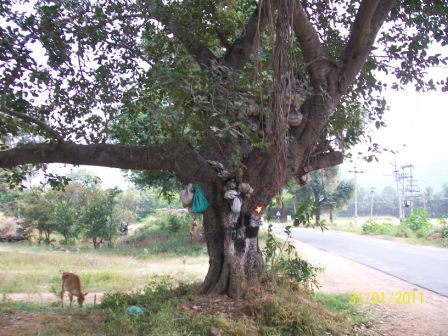
The Magnificent Banyan Tree "Vata Vriksha"

The Banyan at Vellore outskirts-.pic taken by me on 31st Jan 2011.
BELOW 
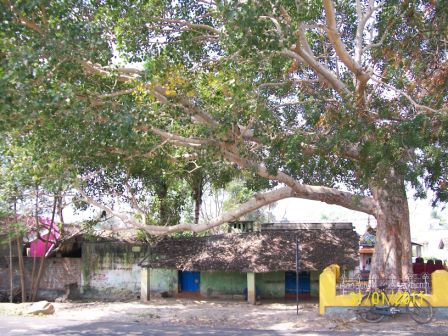
Pic. Banyan Tree  at South Gate, Theosphical Society, Beasant Avenue-
Adyar Chennai 


There are supposed to be more than 3000 types of Ficus Variety of Trees 
-researching the tree is a subject by itself as it has so many connections in religion, culture, tradition, mythlogy, ornamental and even in fiction eg Robinson Crusoe's story -where the house is located in a Banyan Tree - . 

What ever one may feel, the Banyan  it is indeed a magnicent tree and has inspired one and all.Such a tree is in the pics taken near Vellore recently--
FROM WIKEPEDIA
A banyan (also banian) is a fig that starts its life as an epiphyte when its seeds germinate in the cracks and crevices on a host tree (or on structures like buildings and bridges). "Banyan" often refers specifically to the Indian Banyan or Ficus benghalensis, the National tree of India,[1] though the term has been generalized to include all figs that share a unique life cycle, and systematically to refer to the subgenus Urostigma.[2] The seeds of banyans are dispersed by fruit-eating birds. The seeds germinate and send down roots towards the ground, and may envelop part of the host tree or building structure with their roots, giving them the casual name of "strangler fig." The "strangling" growth habit is found in a number of tropical forest species, particularly of the genus Ficus,[3][4][5] Any Ficus species showing this habit may be termed a strangler fig.The leaves of Banyan tree are large, leathery, glossy green and elliptical in shape. Like most of the fig-trees, leaf bud is covered by two large scales. As the leaf develops the scales fall. Young leaves have an attractive reddish tinge.[6]
Older banyan trees are characterized by their aerial prop roots that grow into thick woody trunks which, with age, can become indistinguishable from the main trunk. Old trees can spread out laterally using these prop roots to cover a wide area. Like other Fig species (which includes the common edible fig Ficus carica), banyans have unique fruit structures and are dependent on fig wasps for reproduction.
that compete for light.
The name was originally given to F. benghalensis and comes from India where early travellers observed that the shade of the tree was frequented by banias or Indian traders.[7]
In the Gujarati language, banya means "grocer/merchant," not "tree." The Portuguese picked up the word to refer specifically to Hindu merchants and passed it along to the English as early as 1599 with the same meaning. By 1634, English writers began to tell of the banyan tree, a tree under


The Banyan at Vellore outskirts.
pic taken by me on 31st Jan 2011


Farm scene 2011--Growing Food Crops---

 Namaskar 


Noticed this in History History news-of 1966> 
"The United States announces the allocation of 900,000 tons of grain to fight the famine in India." Wonder how many recall this era with Ration queues etc.
I DO RECALL THIS ---then. I spent many years till 1978 in Shipping just loading & unloading Food Grain Imports from USA and some from Canada too- under PL480. Grain imports tapered off in early 80s only when finally the Green Revolution came in-
Now we see this too in 2011-

Food inflation soars to 17.05 pc, FM gravely concerned

Source: PTI
Costlier vegetables, fruits and milk pushed the food inflation to rise by 1.48 percentage points from 15.57 per cent in the previous week.
The Hindu, 3rd Feb 2011
Costlier vegetables, fruits and milk pushed the food inflation to rise by 1.48 percentage points from 15.57 per cent in the previous week.
Providing no respite to the common man, food inflation rose to 17.05 per cent for the week ended January 22, as Finance minister Pranab Mukherjee expressed “grave concern” and assured steps to moderate it.


Where are we today ? 
rgds
TR


The Farm scene and understanding & learning about our Villages.


In school during the 50s we had an excellent text book on geography titled-
"Living & Earning a Living , which taught us so much about our country and its living conditions, agriculture and industry.It gave us youth a vivid explanationof our Country,  it's people, work and life.
As young students, we thus learnt early that Living was also to work for it in several domains and the basic needs of Food & Shelter -the essentials, was clearly realised -not frills and luxuries alone.
Food today is expensive and takes away about half our earning at any strata in India.
In recent months we have seen the humble item of Onion prices skyrocket and with much controversy satire and wit.....
But how does the Agri scene really work?

These posts and series looks at Farming and the agri sector by studying the simple approaches of Faith in Villagers to Agriculture, Trees..to all of  Nature, with some experiences and photographs taken at several  places in India.
NOTE
I have spent over 45 years working in and seeing the handling of Food Grain, loading on ships --then after 1975 in inspecting imports under PL480 with FCI , later in some exports inc of Rice, Onions and overall in Agri Commodity Inspection like Haldi, Wheat, Oils ,Raw sugar still now--with Lab support .
WE have been working with a series of food managers like FCI, CARE, WFP in PDS schemes etc.


Since 2000 Private Dealers & MNCs entered.
Prices have spiralled with profiteering, hoarding and storage wastage, inc rodents and infestation. 


Today on the Food and agri scene one word would sum it up  thus:
"Food Supply management is a Challenge for all from the farmer to the housewife".

What is infuriating is the middle men and cartels (and add in wastage) who wreck the system and take out the profits leaving the Farmers high and dry.
Even today about 47% of India is agri and forest sector-some of which is non productive due to the complete  lack of basics-even seeds fertiliser and tools- but somehow managing.In fact we  stagnate at the level portrayed in the film" Mother India" in many places  today viz.
1) Farmers are poor -remain poor and in debt- eke out a living and are at the mercy of middle men and cartels. Many have committed suicide-yet work, some how. 
2) Despite Droughts and Floods and all the  vagaries-the crops are harvested---and distributed.
So we some how get our Food grains & Vegetables in our Markets and to our homes daily. 
Thank the Farmers
The photos and narration in this series is from real life experience and a study made  to verify ground reality position in Jan 2011.
Can we usher in some sensitivity &support ? 
Readers opinions are welcome.
Rgds
CaptTR
 TODAY WE ARE AGAIN SEEING FOOD PRICES SOAR --
Recommended reading-

http://www.lifepositive.com/Body/Nature/Farming_in_the_city52009.asp

Benefits

• Enhances food security, increasing the availability and affordability of food, especially perishables. According to the Food and Agriculture Organisation (FAO), it can yield 20-50 kg per sq m every year.
• Provides employment in gardening, composting, input supplies, marketing and distribution of food; also food processing and preservation. FAO estimates that globally 800 million urban residents are involved in such activities.
• Enhances nutritional value, since most of the food is organic and fresher.
• Offers cost and energy savings (in the packing, storage, refrigeration, and transportation of food) by diminishing ‘food miles’. Pollution and greenhouse gas emissions are reduced.
• Replenishes soil nutrients through composting of organic wastes, reducing the costs of present municipal waste management, which contaminates soil and water bodies. Significant ecological, economic and health benefits thus accrue.
• Enhances biological diversity of vegetation, birds, and other fauna.
• Aids soil and water conservation, increasing groundwater recharge, augmenting the quantity and quality of fresh water available.
• Sequestrates greenhouse gases like carbon dioxide in vegetation and the soil, ameliorating global warming, and potentially earning significant revenue in the emerging global economy of carbon trading. • Greens and beautifies cities, moderating the microclimate, making it more comfortable for living; it also enhances the potential for tourism.
• Empowers urban people, increasing community participation, checking social unrest. The enhanced women’s control over food cultivation improves household nutrition.
• Offers meaningful opportunities for nature study and environmental learning, reaching all sections, including the young.
For the first time in history, the human population – predominantly rural until now, has crossed the halfway mark to urbanisation. Today, over 50 per cent of all people live in towns and cities. These occupy less than two per cent of the earth’s surface, but use more than 75 per cent of its resources.
The urban per capita resource consumption is thus thrice that of rural areas. Given the present alarming rate of resource depletion and degradation, such a high ‘ecological footprint’ is plainly unsustainable. City dwellers are unwitting ecological parasites, eroding the very life support on which we vitally depend.

One way out is to encourage the trend of organic city farming, which is already on the rise.

By the end of the last millennium, 14 per cent of the world’s food was reported to be grown in urban areas. Most outstanding has been the performance of Cuban cities, particularly Havana. In 2006, Cuba’s urban (organic) food yield crossed three million tons! Other global success stories include Hanoi and Shanghai. In densely populated Hong Kong, 45 per cent of local vegetable needs were met through intensive cultivation on six per cent of the land.

Havana’s comprehensive strategy for urban agriculture is being replicated in several cities worldwide. In the early 1990s, after the collapse of the Soviet Union and the tightening of the US embargo, urban gardens began to sprout as a spontaneous response to severe food scarcity. The government responded by providing land access and services. In 1994, the world’s first Urban Agriculture Department opened in Havana, undertaking field research and training in organic food gardening. The city’s bylaws were amended to permit only organic methods.

Hundreds of neighbourhood horticultural clubs shared information, ideas, and experiences. ‘Seed Houses’ opened all over the city – to sell seeds, gardening tools, compost, bio-fertilisers, botanical pesticides, etc. at reasonable rates; and to serve as guidance/networking centres. Farmers’ markets and new marketing schemes were created. The deregulation of food prices enhanced profitability and incentive to increase yields. By 2003, urban agriculture provided 60 per cent of the vegetables consumed by Cuban city dwellers. The planting of several million trees (including fruit and nut trees) in and around Havana increased groundwater recharge, improving the water security and water quality of the Cuban citizens.

In India, Pune leads in city farming. Lata Shrikhande, a pioneer, began in the 1980s. She and her friends organised their neighbourhood to separate ‘wet’ (organic) wastes from ‘dry’ (non-biodegradable) wastes, and locally compost/vermicompost the former. Terrace vegetable gardens were initiated. These proved productive, motivating other families to follow suit. Presently, several thousand families compost their organic wastes and grow organic vegetables and fruit. The Pune Municipal Corporation is acquiring a three-acre plot at Salisbury Park – for urban agriculture by interested citizens, to whom it will provide land, seeds, and water free of cost. It is proposed to extend the programme to other city areas as well.

Within Mumbai, the late Dr Ramesh Doshi began over three decades ago. His highly productive terrace garden, growing a wide range of organic foods, featured in numerous press and TV reports. Presently notable is the organic terrace garden atop the staff canteen at Mumbai Port Trust, tended by Preeti Patil and her colleagues. Ms Patil is also the moderator of cityfarmers@yahoogroups.com which has many active members. Maharashtra’s city farming movement owes much to the late Prof S Dabholkar, who inspired, networked, and guided many enthusiasts.

In West Bengal, the East Kolkata wetlands offer the most striking example of traditional urban agriculture and nutrient recycling, employing 60,000 people; and yielding 150 tonnes of vegetables every day, and 15,000 tonnes of paddy every year!

City farming is growing worldwide. It is here to stay.
Bharat Mansata is a writer, editor and environmental activist, involved in natural regeneration and organic farming.
Contact: bharatmansatta@yahoo.com


Agriculture, graam devatas-sthala Vriksha Part 2.

In every village the Faith of the common man is profound-
They have total reverence and regard for  Nature and live in harmony with it-
Simple prayers - offerings from such soul surely  reach the Almighty.
The Village custom of Shedding baggage & worries- is a simple way is surrendering all to the Lord -
Also the Ashwattha (Pipal) Arasa maram is seen as a viboothi of ShreeVishnu -
Below the Gomata -the Cow provides so many requirements.
The effort of the Farmers  seen  in Green Lush crop, just after  Sankaranti  sugarcane, rice planting, banana tree in the fields -31st, January 2011


Sugarcane crops ready-
Banana Plantation
Coconut fringed - Banana Plantations


Below:
Simple dwellings with a traditional shelter & Thinnai for Travellers & Visitors to rest -

Village scene in Tamilnadu- Agriculture, graam devatas-sthala Vriksha Part 1.


India lives in the villages and the Farmers  who maintain the fields-till and toil feed us are seldom remembered. This series of three past is on the Rural scene.The pics were taken at Jamalabad village near Vellore when en route to Kanchipuram :

Saturday, January 29, 2011

Shakambari- Poornima

Shree Matre Namaha
Dedicated to : Shree Devi Shakambari –Mother of Grains, Greens –All Food
for Shakambari Poornima 19th Jan 2011
It is said that in times of famine, Goddess Durga comes down and gives vegan food, (shaaka comes from Sanskrit. means vegetables and vegan food. Ambari means one who wears or bears) , to the hungry. That is why she is called "Shaka" + "Ambari" = 'Shaakambhari'.
Actually Shakambhari comes from Shakam joined with the root Bhri(Shaka = vegetables or food and root bhri = to nourish)

Share & Care is within reach--and in many ways -No doubt,very sobering thoughts at the beginning of a new year, but this Cooperative Effort for Collective benefit of Mankind is what is what have to factor in.Sankaranti ushers in a new period of rejuventaion and so we take up the Yajna Spirit. We in India Culture actually developed the Yajna Principle-applicable to all walks of life viz.Work, Share Cooperate, Receive ...Give--- back cycle...

Today whether it is tree planting or water conservation,the Yajna Principle is seen
Sustainable Living and Working will be the only way to deal with challenges Ahead- 

Introduction Part 1-
The term “BAHUVIDA YAJNA” is  prescribed in our Scriptures. This approach benefits all as wealth produced therefore goes to the collective benefit of the entire world and all its denizens and thereby the “balance of nature” without exploitation, misuse or abuse gets established.  Ecology, Environmental protection, etc. have been recognised in the last two decades after the last century of gross misuse of all resources resulting in de-forestation, pollution, water scarcity, floods, droughts, temperature changes – global warning, etc.
All this has been “Scientifically” recorded and acknowledged. 

When we-family, organisation, or society work together in a “Cooperative Endeavour” the collective enterprise becomes a Yajna; the outcome  is “Lok-Sangraha” which helps all. 
Co-operation is at several planes and is not confined to the material plane only. 
Thus subtle plane of existence and the powers that rule over are respected in the Panch Maha Yajnas. This is the path of long term good for all-  “Shreyas”.   

Modern Management often refers to this as “Sustainable Development” and thereby the  Interdependence of Man and Nature which is an expression of the Divine as Natures balance (Prakruti) in so many forms is established..Thus ‘Yajna’ is seen as the “Kamadhenu”-- that fulfils all needs.All this, extends the Spirit of Yajna to a state of  economic importance. i.e. the Artha aspect of the Purusharthas.

The principle of Parasparam is best illustrated in –
annad bhavanti bhutani
parjanyad anna-sambhavaha
yajnad bhavati parjanyo
yajnah karma-samudbhavaha
 
from Srimad Bhagavad Gita 3.14
“All living bodies subsist on food grains, which are produced from rains. Rains are produced by performance of yajna [sacrifice], and yajna is born of prescribed duties.”
Understanding parasparam bhava and Yajna
The Growth of a blade of Grass- sees the following all supporting and Cooperating.
1) Earth gives space to support growth. 
2) Wind & Birds help in spreading the seeds. 
3) The Sun - Rivers- Sea – Ocean, in fact all water bodies jointly workout an Evaporation & Condensation cycle  for  Rain clouds.
4) Finally again the Wind assists to blow clouds across and then these Rain showers spread across to help it grow. 
 
                                 These  pics taken in my garden teach me this lesson so well.


CONCLUSION-
From the genesis of sowing a seedling, germination, formation the growth of a single  blade of grass gets this benevolent assistance from all of Mother Nature- Surely we all can take the lead from this simple example-
Rgds
TR