Friday, February 11, 2011

Nature Care -A Universal Religion -excerpts.

  • Taking this Blog post all across -
    THE UN HAS DESIGNATED 2011 AS THE INTERNATIONAL YEAR OF   FORESTS TO PROMOTE CONSERVATION & SUSTAINABLE GROWTH.
    When I started this Nature  blog on 25th Decmber 2010 -it was a change from my writing this on emails and postingto select friends- I decided to change to a blog as Eco awareness is a Universal Need- and on which the whole world has acknowledged-  WE need to broaden this awareness and sensitivity to Nature.
    So I started to reference all sources across the world; as a former seafaring Merchant Mariner it was easy to connect to friends all across-  Above all to learn from the Wisdom of every Naturalist &Nature Writer all across. This has been a most rewarding find as We are after all  "ALL CONNECTED ON NATURE"-
    Some gleanings form this are taken:

    T
    his quote was in fact taken for my Blog introduction
    To find the universal elements enough;
    to find the air and the water exhilarating;
    to be refreshed by a morning walk
    or an evening saunter;
    to be thrilled by the stars at night;
    to be elated over a bird's nest
    or a wildflower in spring
    - these are some of the rewards of the simple life.
    ~ John Burroughs, Naturalist (1837-1921) ~
  • He who plants a tree, plants a hope.
    -- Lucy Larcom, Plant a Tree 
  • EXCERPTS

    Plant a Tree in Your Community

    Almost everyone loves trees, but did you know that trees can help people heal faster?

    It's true. According to the International Society of Arboriculture, hospital patients have been shown to recover faster when offered a view with trees. And while trees certainly benefit any landscape -- whether lining residential streets, dotting urban areas, or in full resplendence in the forest -- they are actually important to our daily well-being.


    Trees improve the quality of the air around us by absorbing dust and other particulates. Their leaves also absorb noxious gaseous pollutants, such as carbon dioxide, ozone, carbon monoxide, and sulfur dioxide, before we ever inhale them. Plus, trees protect us from the effects of the sun and from rain, hail, and snow -- which can wreak havoc on unprotected homes -- and emit clean oxygen for us to breathe.

    If the health of people and the environment isn't high on your list of concerns, perhaps your wallet is: Trees make economic sense. A home surrounded by trees costs less to cool and heat. Neighborhoods with trees are often several degrees cooler than those in similar climates that don't have trees. In winter, trees can keep your house warmer by blocking high winds. Also, less water is needed in tree-shaded areas where the sun isn't constantly beating down on the earth below.
    Besides, trees can enhance privacy, block objectionable views, and boost the value of your home. Unfortunately, these days, mass construction projects tend to wipe out all the trees in an area before creating new neighborhoods and buildings.
    That's why it's more important than ever to plant a tree in your community. 

Tulasi- the holy plant and aura effect-


GREETINGS
Maintaining our traditional systems & culture can be done with due regard for eco conservation. A simple Tulasi pot and  a lamp can be easily maintained in every home and a diya (deepa) lit.Tulasi Pooja is a part of our tradition also. 

The tulasi improves the Aura all around which benefits all.This has been researched in Andhra Pradesh- see below:

Research studies by the Institute of Scientific Research on Vedas at different places in Andhra Pradesh has shown the Aura improvement from Trees and plants 
Quote" "It is surprising to know that a 5 feet and five inches and 60 to 70 kgs man would have 2.5 metres aura whereas 1ft and 5 inches height Tulasi plant, weighing hardly 150 gms, gives 6.11 metres of aura," Dr Mannem Murthy points out.
A very well written paper on Tulasi  is Reproduced and gratefully ackd.
RGDS 
TR

Trees and plants in the scriptures

Scriptures of three religions mention their importance of trees and plants.


A must in all homes: Tulasi or basil plant is known for its medicinal properties and is a prime herb in Ayurvedic treatment.
The Buddha Purnima Project Authority in Hyderabad, during this Ganesh Chathurthi season, came up with a novel idea of supplying clay idols along with the offering of fruits and leaves as a package. Nearly thousand kits were delivered to those who wished to offer genuine offerings as prescribed in the method of ‘puja’.
“We struck upon this idea when I noticed all kinds of foliage being passed as traditional ‘patri’ [offering]. Our scriptures have specific mention of which leaves and fruits to use,” N. Chandramohan Reddy, Officer of Special Duty of the authority said. He also makes a point when he says people should be exhorted to respect trees at least for their religious importance. Scriptures of three religions have mention about a great variety of plant life in them. The Koran has mention of over 100 kinds of trees, which includes Acorus calamus (sweet flag), Salvadora persica (Meswak or toothbrush tree), Lawsonia inermis (henna) and Vitis vinifera (grape vine).Especially, during the month of Ramzan, use of Meswak is mandatory as one cannot use toothpaste, except in the dawn. It is one of the ‘Sunnat’ — as the tradition of following Prophet Mohammed during Ramzan is known — to use Meswak to cleanse one’s teeth before each Namaz. Aloe vera, the plant believed to augment beauty as well as health, finds specific mention in the Bible, while Olive does so even in the Koran.
Hinduism, perhaps, accommodates more greenery in its folds than any other religion. 
This is partly due to the myriad scriptures and gods it reveres and the methodical worship of each god. Epics such as the Ramayana and the Mahabharata are replete with descriptions about nature while the 16 scriptures, such as Varaha Purana, Vamana Purana, Kumara Sambhava, Matsya Purana and Vayu Purana, considered holy by the Hindus, mention a number of other trees. Each birth star as well as constellation of Hindu astrology is associated with a specific tree.
Trees such as Emblica officinalis (Amla), Tamarindus indica (tamarind), Mangifera indica (mango), Achyranthus, Terminalia arjuna, Calotropis gigantean, Saraca indica (Ashoka), Ficus religiosa (Peepal), Zizyphus mauritiana (Indian jujube), Eclipta prostrate, Aegle marmelos (Bael tree), Michelia champaca (Champaka), Datura, Artimisia pallens (worm wood), Cynodon dactylon (Bahama grass), Leucas aspera (Thumbe), Clitoria ternatea, Syzygium cumini (Jamboo), Hibiscus rosasinensis, Asparagus racemosus (Asparagus), Anthocepalus cadamba (Kadamba), Nelumbo nucifera (Lotus), Feronia elephantum (Kapitha or Velaga), Nerium odorum (Karaveera or Ganneru), Pandanus species (screw pine), Bauhinia species, jasmine, Origanum marjorana, Mesua ferrea, betel leaf, Tabernaemontana divaricata, water lily, Vitex species, Butea monosperma, Nyctanthes arbortristis (Parijatha or night jasmine), Areca catechu (areca nut), Calophyllum inophyllum (Punnaga), Chrysanthemum species, Prosopis cineraria, Santalum album (sandal), Polianthes tuberose (tube rose), Elaeocarpus sphaericus (Rudraksha), Calotropis procera, Ocimum sanctum (Tulsi), Ficus racemosa (Gular fig), Mimusops elengi (Pogada), Ficus bengalensis (Banyan) and Evolvulus alsinoides (Vishnugandh) are widely used in different kinds of rituals performed by Hindus during various pujas and vratas.
Quite many plants including Holarrhena antidysenterica, Atrocarpus lakoocha, Syzygium aromaticus (cloves), Pinus longifolia (pine), Saccharum officinarum (sugarcane), Dalbergia latifolia (rosewood), and palmyra palm find special mention in the Ramayana as they supposedly existed in ‘Ashoka Vanam’ where Sita was kept imprisoned by Ravana.
Any one with even minimal knowledge of Hindu religion knows the significance of mango leaves which are used for festooning during auspicious occasions.
Peepal tree symbolises the trinity of Hindu religion Vishnu, Shiva and Brahma.
Buddha is said to have attained divine knowledge sitting beneath this very tree at Gaya.
The tree is also worshipped by childless couples.

Tulsi or basil plant is widely known also for its medicinal properties and is a prime herb in Ayurvedic treatment.
The plant’s extracts are used to prevent or cure many ailments such as common cold, headache, stomach disorders, inflammation and heart diseases. As a Mosquito repellent.
Also used in herbal toiletry, the plant is known to de-pollute the atmosphere and repel mosquitoes.
A few trees such as pomegranate find place in all the three religions.
Pomegranate is mentioned in the Koran, the Bible, the Ramayana, the Mahabharata and Matsya Purana, Varaha Purana and Vamana Purana. 
Trees such as date palm and Fig follow suit.
Adansonia digitata or the glamorous Baobab tree, native to Africa and introduced to India about 1000 years ago, is considered as ‘Kalpavriksha’ in some parts of the country.
Depending on nativity and use, many other trees such as Parijata, Peepal, banyan and coconut too are considered as ‘Kalpavrikshas.
SWATHI V.
see also-http://www.ecoindia.com/flora/trees/

Kitchen Garden series-002 -BILIMBI (Averrhoa Bilimbi)

Greetings- 
The simple Bimbla fruit -BILIMBI (Averrhoa Bilimbi) is popular in homes where it is grown esp in South Kanaras. It it used in curries to add taste and popular as a home made  Pickle. It is rich in Vitamin C-
Bimbla (Bilimbi) is not often seen in markets,but this tree is grown in many homes of our South Kanara families in cities inc. Chennai and shared with friends -It is a part of the kitchen garden plants-trees.
refer photos.
I have attached 4 photos I took of Bimbla Tree recently
2 are from my relatives house in Chennai--
See part tree branch cut Pic no 1- (pruned badly, but still Tree is kind and gives Fruit  Pic no 2 in Feb 2011.
3rd  pic is from Tree pic taken at  Jogeshwari... Mumbai -Jan 2011  - 

BILIMBI (Averrhoa Bilimbi)
This fruit is shaped like a mini cucumber about 2 t- 3 inches long. It is greenish- yellow when ripe. Tastes like the starfruit or Karmala of West Coast India Fruit-- is sour and used for home made pickles and garnishing curries in south. Vitamin C rich .
RESPONDING TO A READER'S QUERY
Growing a Bimbla Tree.
In most places in India,  February is seen as  the best time to grow -

Ideally, get a good Sapling from a Nursery -cost may be abt. Rs.125/
Best to  plant in the ground--need only a small space; 
Tree will grow abt. 7 to 10 feet tall (needs full sunlight) .
Much depends on where one is  residing?
Flat or House and type of Weather you have.
Esp. Soil -Water - etc?
May be grown in a clay or concrete pot but needs a large kind -with a drain hole at bottom -water must not stagnate  should be able to flow out slowly- 
Get good earth... mix with sand, gravel
Use Organo Natural Manure costs approx Rs 100 per bag only
Water with care do not Flood
Keep in open sunlight
Ref Potted Saplings -
 POMEGRANATE  Tree-plant and Fruit in Pune on a 7th Floor Terrace Garden, in Pune.


In Pune I saw Pomegranate grown in a Pot by Shri Kale --the Gardener -
on a 7th Floor Terrace Garden.
Truly a Green thumb--what in India call "Daiva Kala"- (haath guna ) in Greenery. 
So we can  try ----but have  a good gardener to assist -  
Look after plants kindly---with care daily;  they respond well
Kind Rgds
TR
For ref from net sources:
This is essentially a tropical tree, less resistant to cold than the carambola, (Karamala ) growing best in rich and well-drained soil (but also stands limestone and sand). The bilimbi tree is long-lived and reaches 5-10 m in height.
Its trunk is short and quickly divides up into ramifications. Bilimbi leaves, 3-6 cm long, are alternate, imparipinnate and cluster at branch extremities. There are around 11 to 37 alternate or subopposite oblong leaflets. The leaves are quite similar to those of the Otaheite gooseberry. It prefers evenly distributed rainfall throughout the year, but with a 2- to 3-month dry season.

Kitchen Garden trees and plants "sustainable economy"


Kitchen Garden trees and plants:  for home economy.
The Coconut, Banana,Mango,Tamarind,Jackfruit,Bimbla, Papaya,Guava, Sapota(Chickoo) are seen in most homes where there is space to grow them. 
I  tried this in the rear and side spaces of my compound; the Coconut, Papaya, Banana, Guava were grown successfully with other flower plants. Maintenance is required and time has to be spent to cultivate and nurture them with soil and organo mix, pesticides, herbicides etc  as they are subject to infestation,fungus and insects etc -but, well worth the time and effort.
This series will now try to cover them.
In my side space  5 ft width we have managed to grow this- with herbs also.
Banana trees are actually considered to be very large perennial herbs.
Every part of the banana Plant-- stem, leaves fruit is used in Indian Homes-and is indispensable to our life style and culture.  
The Banana Plant-  grow well in our Tropical  climates. 
They are seen as  the perfect addition to a well-planned organic garden.

Bananas at a plantation-below:
 Banana Plantation -
 Pic.taken in Chennai -typical scene in south, where every home grows such trees.

Rgds

TR

How To Grow and Care for Banana Tree 

Some suggestions taken from Home & Garden by Carrie Grosvenor is taken for reference:

No matter where you live though, there are a few things you'll need to know in order to keep your banana trees thriving.
  1. Banana plants prefer a light, well-draining soil. You can aid in the drainage quality of your planting beds by adding raised areas above heavier soil to allow the thin roots of the banana tree to spread.
  2. Choose the warmest location on your property for banana plants. They really need full sun; twelve hours a day is optimal. If you live in a temperate climate, your banana plants will also need protection from wind and cold. Banana trees do not like winter!
  3. If you plan to keep growing banana plants throughout the year and live in a zone with seasonal cold weather, choose cold tolerant varieties of banana trees such as Musa Basjoo, Saja, and Ice Cream.
  4. Some banana plants are strictly ornamental, while others bear fruit. Read tag descriptions carefully so you'll know what to expect. Almost all banana plants have the potential to grow very tall, except for dwarf varieties. Be prepared for this - young plants won't stay so small. 
  5.  
Unquote

Tuesday, February 8, 2011

Ved Mata Gayatri devi

 OM- NAMASKAR

Ved Mata Gayatri devi is tripad i.e. as Gayatri (pratha sandhya), Savitri at madhye -noon, and Saraswati at saayanakale sandhya.
She is the one who illuminates our Intellect as we seek in  our mantra.


Quote:
Sandhya merges in Gayatri
Gayatri merges in AUM-
Aum merges in Brahman
Unquote.  

                    
The sigbificance of Trikaal sandhya is purification and growth  as under:
1.Pratha kale (Morning)  to Sri Gayatri is  over Indriyas (5 senses organs).
2. Madhye (at noon)  to Sri Savitri over Prana.
3.Saanykale (evening) over Speech –Vaak to Sri Saraswati.

e) SIGNIFICANCE: & SYMBOLISM.
The Sun is Light –Tejas and giver of Life is the visible and symbolic of Eshwara as the “Pratyaksha Devata” viz the seen form of Divine and without Surya Deva, there is no life  - (Refer descriptions in Sri Rudra, Gita and Devi Paat.)                                       
So our sandhya vandana  mantra i (conjunction) is for antar-atma uniting with  param-atman in the space of one’s heart i.e. Parama Vyoman or Sky i.e. Hridaya Akash.
The inner spiritual light is like a sun reflected in our mind (consciousness).


Sharada Stotram -Vaak devi
Prayer to Goddess of Learning-
Translated by P. R. Ramachander

http://www.celextel.org/stotras/devi/sharadastotram.html
[Goddess Saraswathi is worshipped as Sharada Devi in the famous temple at Sringeri.]

Namasthe Sharade devi, Kashmeera pura Vasini,
Thwam aham prathaye nithyam, vidhya dhanam cha dehi may. 1

Salutations to Goddess Sharada who lives in Kashmir,
I pray you daily and so give me knowledge as gift.

Ya Shradha, dharana medha, vagh devi vidhi vallabha,
Bhaktha jihwagra sadhana shamadhi guna dhayini. 2

You are attention, understanding, wisdom, goddess of speech and consort of Brahma,
Sitting at the tip of the toungue of your devotees, you grant peace and all that is good.

Namami Yaminim nadha lekha alankrutha kunthalam,
Bhavaneem bhava santhapa nirvapana sudha nadheem. 3

Salutations to her who decorates her tresses with the darkness of night and sound of writing,
And to Goddess Bhavani who cures sorrow due to life like a river of nectar.

Bhadra kalyai namo nithyam sarasvathyai namo nama,
Veda vedanga vedantha vidhya sthanebhya eva cha. 4

I salute daily you as Bhadra kali as well as salute her as Saraswathi,
As you are the home of Vedas, branches of Vedas, philosophy and knowledge.

Brahma swaroopa paramaa jyothi roopa sanathani,
Sarva vidhyadhi devi ya thasyai vanyai namo nama. 5

Salutation to Vani who is the goddess of all types of learning,
Who has the form of Brahma, the ultimate light and is for ever.

Yaya vinaa jagat sarva sasva jeevan mrutham bhaveth,
Jnanadhi devi ya thasyai saraswathyai namo nama. 6

Salutations to Goddess Saraswathi, who is the supreme goddess of wisdom,
Without whom the entire universe would appear dead even though it is alive.

Yaya vinaa jagat sarvam mooka munmathavad sadaa,
Ya devi vaghadhishtathri thasyai vanyai namo nama, 7

Salutations to goddess Vani, who presides over the act of speaking,
Without whom this world would be dumb, confused and lost.

Monday, February 7, 2011

Shree Vasant Panchami -today Salutations to the Divine Mother

dt 8th Feb 2011.
 Om Shree Matre Namaha -

A Glimpse of the Divine Mother Shree"Mata Saraswati"-


Anu Roope, Maha Roope, Vishva Roope, Namo Namah.
The Divine Mother is Creation itself i.e. Prakruti and our shastras have described her in every glorious form that humans can imagine.
 She is  described in Namavallis as :
Vagdevi                              – Goddess of Speech
Jihvagravasni                     – Dwelling at the tip of the tongue
Kavijih Vagravasini              – Dwelling on the tongue of Poets
Shabdavasini                      – She who dwells in Sound
Vagisha                              – Mistress of Speech
Mahavani                            – Of great wisdom in Speech
Smriti-Sakti                        – Power of Memory
Jnana-Sakti                        – Power of Knowledge
Buddhi Sakti Swarupini      – Whose form is the Power of Intellect
          Kalpana Sakti                     – Who is the Power of Forming ideas.
Pratibha Sakti                    – Intelligence
Veda Garbha                       – the womb-source of Vedas Knowledge.
Sarva Vidya Swarupini        – All forms of Knowledge
Sarva Sastravasini              – Dwelling in the Shastras (Books of Shastra)
Granthakarini                     – Who creates the Books.
(All these and more are explained in the Shree Lalita Sahasranama stotra & Namavalli).


Naturally, as a Mother she is loving, gentle, kind and compassionate and caring.
As her children we also see her as beautiful and ever radiant. (Dhyana Slokas in L.S.) 
She protects, guides and also chides us when we go astray and brings us to the correct path.Thus she is Guru Murtaye Namaha and we offer our prayers and salutations.
 

NOTE
In the Srimad Bhagavad Gita Chp 10 Sl 10, 11, 22, 33, 34 and in particular Sl 33, refers to the feminine qualities of” Kirtih, Shree, Vak ca narinam, Smrtir, Medha & Kshama viz. Fame, Fortune, Speech, Memory &  Intelligence with Forbearance & Forgiveness.
Regards 
TR.
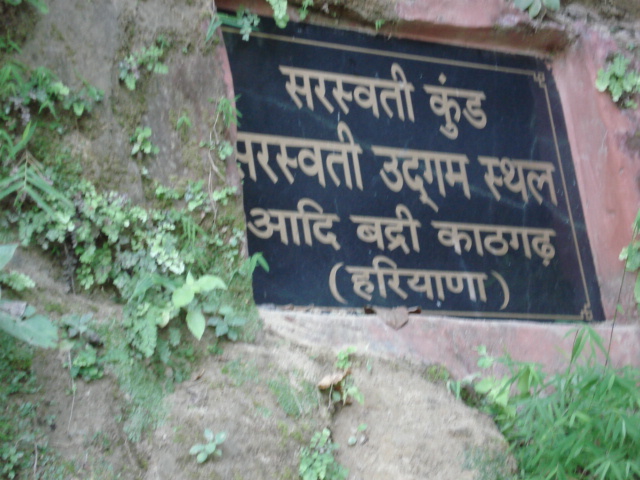
At Saraswati Teerth Yatra -Kurukshetra-- Harayana -Adi Badri

Shree Vasant Panchami -

Dt. 7th Feb. 2011.
Shree Vasant Panchami- Spring arrives-

White Bougainvilla at our home "Mahalakshmi"
Ixxora bloom -
Bougainvilla blossoms in white
Bilwa Tree in fruit -

Bimbla tree -green
Fields -(pic taken earlier at Gujarat)
Vasant Panchami is celebrated in Yellow colours


Saraswati is venerated on Vasant Panchami.

Vandana:
Yaa Kundendu tushaara haaradhavalaa, Yaa shubhravastraavritha|
Yaa veenavara dandamanditakara, Yaa shwetha padmaasana||
Yaa brahmaachyutha shankara prabhritibhir Devaisadaa Vanditha|
Saa Maam Paatu Saraswatee Bhagavatee Nihshesha jaadyaapahaa||

Translation:
"May Goddess Saraswati,
who is fair like the jasmine-colored moon,
and whose pure white garland is like frosty dew drops;
who is adorned in radiant white attire,
on whose beautiful arm rests the veena,
and whose throne is a white lotus;
who is surrounded and respected by the Gods, protect me.
May you fully remove my my lethargy and ignorance."


Mother Saraswati --in alankar -from Shiv Krishna Mandir, Hubli
Above: Milkweed flowers are used in Ganesh Pooja in Tamilnadu
Below:ShreeGanesh -today is S4- Chaturti- Magh Shree Ganesh Pooja

Namaskar to Guru, Ganesh & Mother Saraswati


Shree Vasant Panchami, heralds the arrival of Spring--and the whole ambience is filled with afreshness and all over we see new leaves, blossoms, fruits and flowers –

The Divine Mother is Manifested in all Creation as Nature-Prakruti.

The Divine Mother is seen in myriad forms and  we have a glimpse of her at Uttarayan , on the auspicious date of  Vasant Panchami when Shree Saraswati  is worshipped.
The Magh & Sharad Navaratris when the 3 principal forms of worship  are:
Shree Durga, (Icchha Shakti) –
Shree Mahalakshmi (Kriya Shakti)
Shree Maha Saraswati (Jnana Shakti)- 

From Vimarsha to Prakasha


Appreciation of any aspect of Prakruti is a basic quality  needed in our quest for Inspiration and then only we can  reach for Aspiration to the higher;

 then as a Bhakta we develop.

With Appreciation we gain the impulse ‘from within’ and  learn.

In Appreciation we grow spiritually.


SUMMARISING


In Samvit Sadhana,  Vimarsha has been described as Flashes of Inspiration. This is intuitive due to Medha + Prajna and  not mere book knowledge. It is only with Shraddha , Bhakti & Anugraha Kripa that  we gain this  blessing of Inspiration from the Divine Mother. Thus we progress only with Bhavani ( Bhakti , Bhavana +  Vani. )-from teachings of Sw Iswarananda  

Respects 
TR

NOTE
I have actually felt Spring "Vasant" effect,  even in crowded cities; and in places  that do not really face a bleak Winter with  the arrival of the season and it   is evident in the trees, plants and in the air;
a new begining filled with hope.Vivid colours Yellow, Green and Bright ----
The Divine Mother blesses all- with her glance and touch- seen in all of Nature
 
 
 With our Swamiji at Pooja- during Shree Saraswati Teerth Yatra to Adi Badri, Haryana.