Wednesday, February 29, 2012

Kahlil Gibran--Nature Lover

Kahlil Gibran as a Nature Lover is ackd and admired over the world and even Religious Teachers quote him. Quote" A powerful advocate of the unity of being and of universal love on the one hand, and as the child of nature and creation par excellence on the other. And in his posthumous works written in English, the environmental message of Gibran reaches its peak, notably in the gentle compassion of "The Wanderer"
The Lebanese poet and philosopher Kahlil Gibran (1883-1931), best known as the author of book -The Prophet,
--REF
KAHLIL GIBRAN:
POET OF THE ECOLOGY OF LIFE

BY DR. SUHEIL BUSHRUI
All things in this creation exist within you, and all things in you exist in creation; there is no border between you and the closest things, and there is no distance between you and the farthest things, and all things, from the lowest to the loftiest, from the smallest to the greatest, are within you as equal things. In one atom are found all the elements of the earth; in one motion of the mind are found the motions of all the laws of existence; in one drop of water are found the secrets of all the endless oceans; in one aspect of you are found all the aspects of existence. - Kahlil Gibran.

The Lebanese poet and philosopher Kahlil Gibran (1883-1931), best known as the author of book -The Prophet, is widely regarded as a man of the East who brought a much needed element of spirituality to the West. But he was far more than that. Brought up in a breathtakingly beautiful countryside and steeped in a tradition that synthesized the great legends of Adonis and Astarte - the gods that were an integral part of the natural world of the imagination - he became one of the most environmentally aware writers of the early 20th century. He saw the body of the world as an outward manifestation of the divine essence, not as an object to be manipulated, rearranged and remade according to material desires and whims.


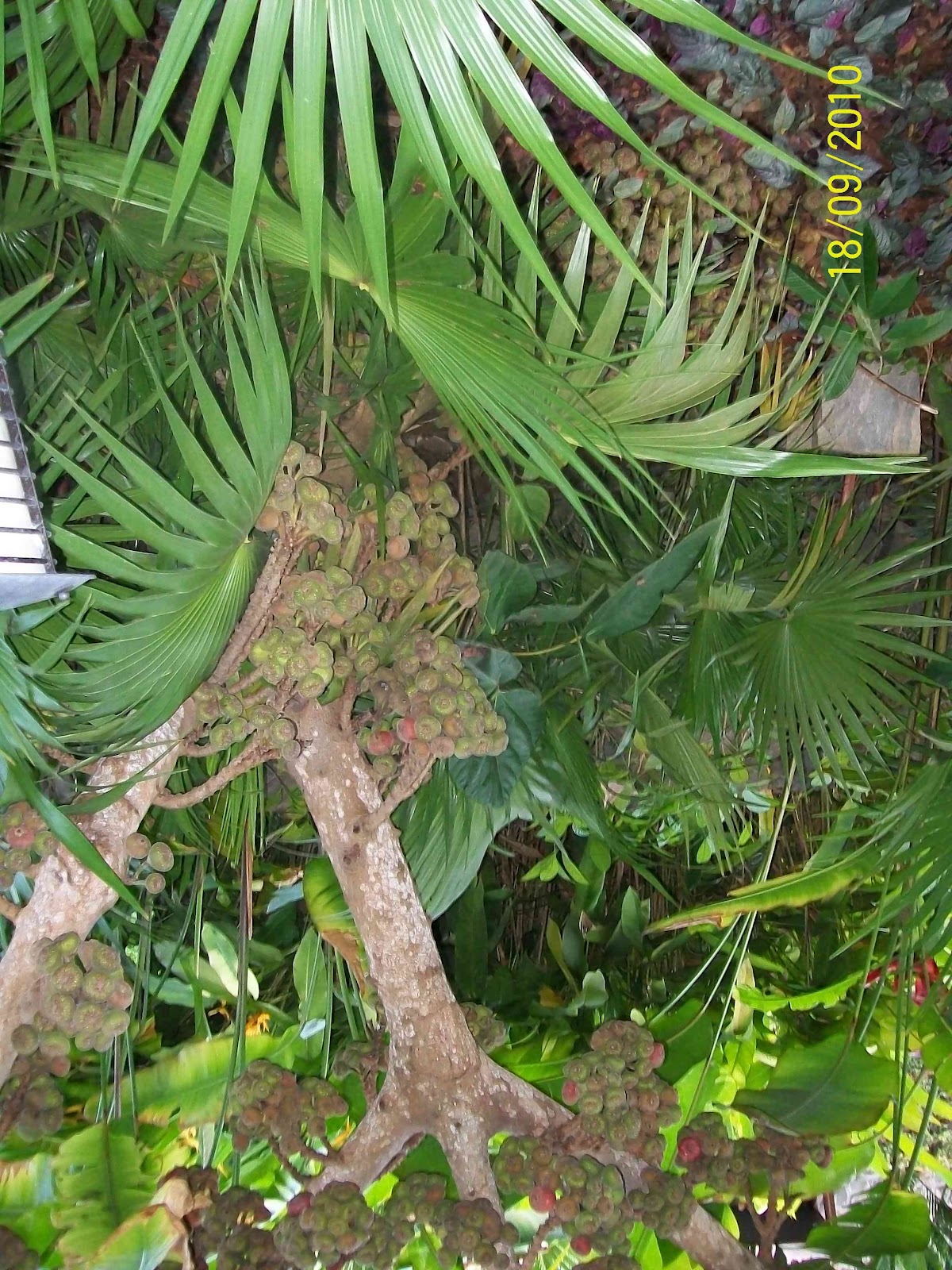
2 Pics of Kovalam taken by me at TAJ, Vivanta.


1) Said a tree to a man, "My roots are in the deep red earth, and I shall give you of my fruit."
And the man said to the tree, "How alike we are. My roots are also deep in the red earth. And the red earth gives you power to bestow upon me of your fruit, and the red earth teaches me to receive from you with thanksgiving."

2) "These plants that live upon the tree draw the milk of the earth in the sweet stillness of night, and the earth in her tranquil dreaming sucks at the breast of the sun.


3) "We live upon one another according to the law, ancient and timeless. Let us live thus in loving-kindness. We seek one another in our aloneness, and we walk the road when we have no hearth to sit beside.

"My friends and brothers, the wider road is your fellow-man.

Gibran establishes the true relationship between man and nature. With his view of heaven in a dewdrop and the phenomenon of the stars themselves speaking to him Gibran's speaks of the  world in which nature is both his mother and his sister.
UNQUOTE

Most inspiring 
TR

---------------------------------------------------------------------------------

Tuesday, February 28, 2012

Figs-Ficus Anjeer -----

Figs-Ficus Anjeer WE relate to Anjeer easily as a dry fruit or in ice cream -and Fig syrup for digestion given to children esp even today. Many think of Fig leaf and covering in Adam &Eve only .
At Taj-Vivanta Kovalam two years ago , I took a few pics of a Java Fig tree which had been imported  from Java -in the wide gardens of the locaton -see pics. In the last 3 years I have studied the available data on figs esp the history and find it dates back 1000 years or more BC in recorded History---and in fact stretches from Europe to US - to -West Asia-Middle East to  India---all the way to  South Pacific Java etc. Dates and usage in so many cultures and ways is well recorded. 
Figs have an  amazing story as it is connected in all places across the world and acrossTIME-
Some interesting facts:
FIGS have 3  vegetative characteristics- 
a.Figs possess a white to yellowish sap (latex), some in copious quantities.
b.The twig has paired stipules or a circular stipule scar if the stipules have fallen off.
c.the lateral veins at the base of the leaf are steep, that is they form a tighter angle with the midrib than the other lateral veins, a feature referred to as a "tri-veined".
This is a Java Fig tree pic--taken  at Taj Vivanta Kovalam -Sept 2010.
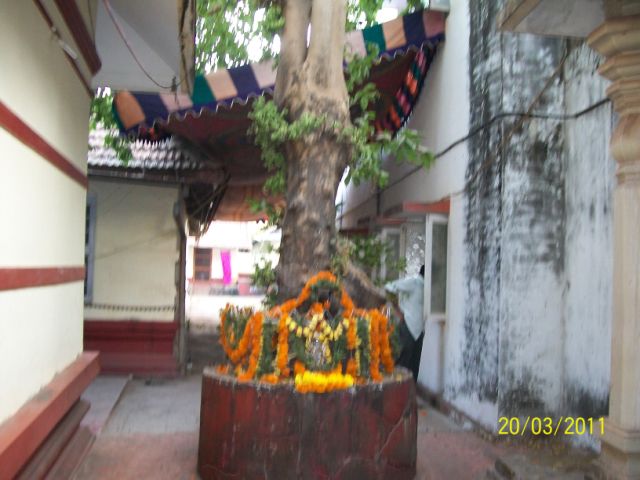
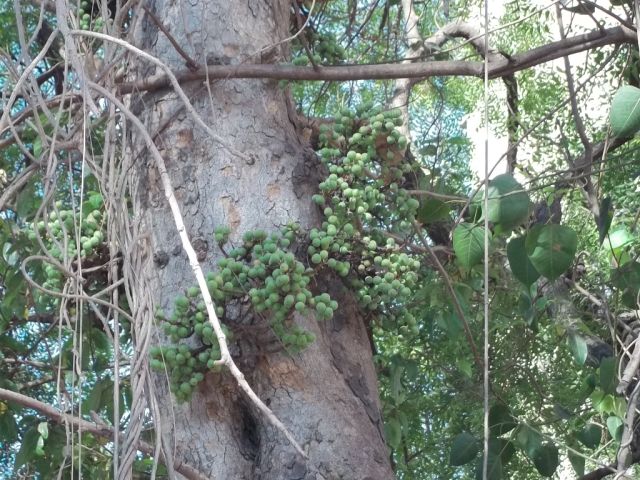
Pics  taken in Uma Maheshwari temple, Mangalore Feb 2011;
See esp    close up pics of Oudamber "Moracea"  Tree &-leaves with Wasps effect on leaves ..Wasps  pollinate them -fig- tree  connection is amazing.
Figs are Tropical in origin -inc Mddle East and Temperate climates esp South Europe -Mediterannean (Common  Fig-F Carica F ) Many other kinds of figs and berries are seen;  most are edible or used for medicinal value and eaten by birds, primates & bats  and have served as food & nutrition for dry lands esp few others.

Quote" CULTURAL VALUE OF FIGS
Figs have religious and cultural importance in worship and for their many practical and medicinal uses. 
DATING THE FICUS GENUS --
There is no clear evidence from older fossils of Ficus trees, but a  "molecular clock study and carbon dating process" estimates ( indicates) that Ficus is a very ancient genus; maybe even millions of years old.
However  it is without doubt an Ancient Tree genus and about 800 kinds are recorded  over the world with so many legends and folk lore even attached.--
Readers choice to decide.
Rgds 
TR

Saturday, February 25, 2012

STHALA VRIKSHAS--Trees at Hubli Shree Shiva Krishna Mandir

The 2 Sthala Vrikshas here are both Ashwattha for ShreeKrishna & Oudamber for Guru - Lord Shiva- -ShreeDattatriya -ShreeDakshinamurty -Rgds
TR

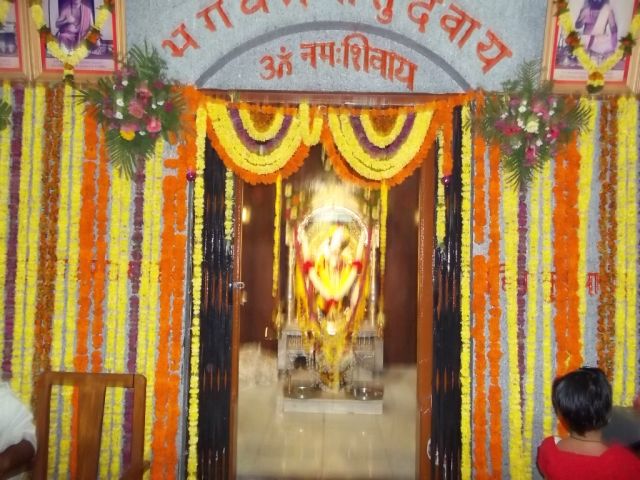
Shivratri 20th Feb 2012, at Hubli -Shree Shiva Krishna Mandir

SHIVA MANTRA
The Shiva Pancha-akshari Mantra of OM Namah Shivayah in simple terms means:
“OM LORD SHIVA, SALUTATIONS TO THEE- ”. 
This mantra is also explained thus:

OM - Pranava is Absolute Brahman i.e. God without Form, name, shape. Etc

NA – Prithvi tattva (earth - material as ash)

MA – Jala tattva (water content in our body)

SHI – Agni tattva of Tejas as in the Sun & Heat of body temperature.

VA- Vayu tattva  as the vital energu force of pancha prana

YAH – Akash (sukshma aspect) and is the  space  for circulation in our body and in universe for the spirit to move.                                               

NOTE: The name RA-MA letters are taken as RA from Om Namo NaRAyana and Om naMAh Shivaya. This teaches us that Eshwara is one only in differenbt forms …ekam sat viprah bahudavanti.

From the new Hindu Prayer Book -
वन्दे शंभुं उमा-पतिं सुर-गुरुं, वन्दे जगत्कारणम् ।
= vandé shambhum umā-patim sura-gurum, vandé jagat-kāraṇam |
= Salutations (vande) to the good-doer (shambhum), to the husband of pAravtI (umA-patim), to the guru of the gods (sura-gurum), salutations to the reason (kAraNam) of the [manifest] world (jagat) |

वन्दे पन्नग-भूषणं मृग-धरं, वन्दे पशूनां पतिम् ।
= vandé pannaga-bhūṣhaṇam mṛiga-dharam, vandé pashūnām patim |
= Salutations to the one who is adorned by serpents, to the one protects the animals, salutations to the Lord of animals.

'pashu' literally means 'the one has been snared in a net'. Figuratively we are all pashu snared in the net of attachment, not realizing the true identity.

वन्दे सूर्य-शशांक-वह्नि-नयनं, वन्दे मुकुन्द-प्रियम् ।
= vandé sūrya-shashāṅka-vahni-nayanam, vandé mukunda-priyam |
= Salutations to the one whose eyes are the Sun, Moon (physical world) and Fire (Knowledge), salutations to the one who is dear (priyam) to Vishnu (mukunda) |

वन्दे भक्त-जनाश्रयं च वरदं, वन्दे शिवं शंकरम् ॥
= vandé bhakta-janā_shrayam cha varadam, vandé shivam shaṅkaram ||
= Salutations to the refuge (Ashraya) of devotee (bhakta-jana), salutations to the auspicious (shivam) and good-doer (shaMkaram) ||
SOME SPIRITUAL MEANING & SYMBOLISM- subtle (sukshma aspects)
a)     Rudra is Energy  and in the Ghora roopa “Rudra roope” includes  the attributes of Strength, Heat Potential &Anger aspects amongst others and all. This prayer is to keep the anger and strength in check. Suryadevata is the blazing red hot heat and the Rudram also covers the aspect as Surya aschame etc. 
     See Anuvaak No.1. NOTE: We cannot even sight the Sun except at sunrise sunset…  How can we see God “ Eshwara”  with our physical vision (eyes) and thus we say God is INFINITE. This helps to gain an idea of the term “Absolute, Infinite , Nirguna, Para-Brahman”
b)    Nandi vahan represent  Dharma. & stability of the Lord –the Creator.
c)    Shiva -Parvati symbolise the Potential & Kinetic Energy.  
d)    Kailasa is a peak and we get inspiration to Reach High in our Spirit. This begins with   self improvement as in Art of Living.
d)    Eshwara worships Rama – “Ramasya eshwara” and Rama worships Eshwara – Rameshwaram. 
Respects 
TR

Saturday, February 11, 2012

3 Trees in Shree Vishnu Sahasranama


  • 3 Trees in Shree Vishnu Sahasranama 

    dt 12th Feb 2012

    GREETINGS
    4 names in Shree Vishnu Sahasranama are taken up viz
    Sulabha,--- Nyagrodha,Udumbara,Ashwattha

    Brief explanation :


    Prefixed with "Sulabha"- 817. easy to do means: The lords blessings are easily obtained by Bhakti alone-When the creation gives a leaf,flower, fruit , water we can offer with all our love - mind & heart. REFER leaf,flower, fruit ,water--when offered with pure devotion ref. Chp 9 Gita. -
    the Anugraha -of lord is Sulabha- easy to obtain .This is to enable a devotee to seek and strive to Parama-Purusha by the simple way of Devotion alone.


    Three Trees 


    1) The Banyan Tree: "NYAGRODHA"-822. name has been derived from the analogy to this tree- and it's Roots; but here the Aerial Roots have been used in analogy; Roots grow downwards firmly holding it--but  -aerial roots in  of a Banyan and the Tree stands tall, spreading all scross, giving shade to all-anyone  under a wide canopy -
    i.e. The Lord stands above VIEWING CREATION...Protects all, gives shade to all .
    There is no sectarian outlook in Mother Nature's care.


    The Banyan also symbolizes Trimurti with Vishnu as the bark, Shiva as the branches and Brahma as the roots. Indian culture acks the Banyan tree as 'Kalpa Vriksha' the tree that fulfill all your wishes.Thus the mighty Banyan Tree is considered as immortal and has always been the focal point for the village communities in India. It is probably the biggest and friendliest of all trees- used by people as a shady place to rest.
    Several meanings in analogy are taken with the Banyan tree and they are far reaching
    • As Vata Vriksha as in Shri Dakshinamurthy stotra.
    • The Banyan tree analogy is explained in detail in Gita Chp 15- Inverted Tree of Life and is accepted as an Upanishad.  


    2) UDUMBARA. 823.- Has several meanings inc food, nourishment, --the one who nourishes the universe,
    The name derived from ut-ambarah, i.e. issued from the Sky-
    the Supporter of universe, cause of creation and it's sustenance.
    As food from shruti- urgva annadyam, udumbaram.
    thus we have the upanishadic statement "Annam brahmeti"-food indeed is God.


    OUDAMBER-Dattatreya Guru:  son of the Rishi Atri and Anasuya. His birth was a divine boon, hence his name: Datta–“given”–and atreya–“son of Atri.” Considered a divine incarnation and known as the Lord of Avadhutas, is  revered as the embodiment of the Supreme Guru. Also authorship of the Avadhuta Gita, the Jivanmukti Gita, and the Tripura Rahashya. 
    ASHVATTHA-824. svah tishtati iti svasthah -means that which will stand tomorrow also-i.e. to explain permanency or symbolic of  permanent, not taken away by time,,,is Asvattah.
    Ashwattha -Pipal tree-Scientific name Ficus Religiosa
    The tree of enlighenment of Gautama Buddha-called as  Bodhi Tree (peepal tree)


    GROWTH - Banyan Tree ( FICUS BENGHALENSIS)
    The Banyan is of a Ficus genus ( by figs) actually starts as a Fig-as an Ephiphyte when its seeds germinate any where –sometime in most unusual places a Tree-or a cement crack even in the cracks and crevices of buildings. The seeds of banyan are distributed all over at random by Birds and Wind The Sapling sends down strong roots and they may even expand and twist around and take over its base and cover the host tree esp.
    The name Strangler Fig is used for Banyan & Pipal esp. when Roots take control over place of origin NOTE-See the Trunk of such trees in many places, even public places and roads where Roots twist all around for growth and search for moisture and sunlight , got the name “strangler fig”-seen in many trees.
    The leaves of Banyan tree are broad dark green and thick like plastic and elliptical in shape.
    Young leaves have a reddish shade. Older banyan trees have Aerial Roots that grow from main trunk-into Giant Trees with age and cover a wide area.
    Natures Wonder

    TR
    Thought" Protect all Plants and trees -flora & fauna"
    Dharmo Rakshati, RakshitaH
    (Protect Dharma and it will protect you)


    SOURCES -The Aswattha  (Arasa Maram in Tamil ) is worshiped in most parts of India and a murthy of God is consecrated below the tree. In Kerala and Tamil Nadu, the family which plants the tree, does a sacred thread ceremony to the tree and then conducts its marriage with the neem tree. Most of the Naga Temples in Kerala and Ganesha temples in Tamil Nadu are constructed below this tree. Women who are not able to beget children are asked to go round the tree daily. The great shade of the tree is used as the meeting place of senior citizens in every village.


  • Srimad Bhagavad Gita Chp 15: There is a banyan tree which has its roots upward and its branches down, and the Vedic hymns are its leaves. One who knows this tree is the knower of the Vedas." (-Gita 15.1) Here the material world is described as a tree whose roots are upwards and branches are below. We have experience of a tree whose roots are upward: if one stands on the bank of a river or any reservoir of water, he can see that the trees reflected in the water are upside down. The branches go downward and the roots upward. Similarly, this material world is a reflection of the spiritual world. The material world is but a shadow of reality. In the shadow there is no reality or substantiality, but from the shadow we can understand that there is substance and reality. In the desert there is no water, but the mirage suggests that there is such a thing as water. In the material world there is no water, there is no happiness, but the real water of actual happiness is there in the spiritual world.


  • --------------------------------------------------------------------------------------------------------------------------------------------------------


  • FROM SOURCE: moola mantra, significance
    • Moolatho Brahma roopaya, madhyatho Vishnu roopine,
      Agratha Shiva roopaya Vruksha rajaya they nama., 1.

      My salutations to the king of trees. Whose root is the form of Brahma,
      Middle is the form of Lord Vishnu, And top is the form of Lord Shiva


  • Sunday, January 1, 2012

    TreeWatch -Mumbai city area,

    GREETINGS

    Jan 1st,  2012.

    "Hasten Slowly & Observe"
    Just returned froma Mumbai -Shirdi trip.
    Greetings on the morning of 2012 ..first post on this blog.
    In a busy metro like Mumbai -often called a concrete jungle , it is wonderful and also amazing to see so many Banyan Trees  spread all across nurtured from near Gateway of India, Colaba  to Oval Maidan to Crawfort Market ..
    -Mumbai is an unusual city for Nature Watch-.
    I was staying in city area this time and walked a bit around/ in Metro-Marine Drive -Oval Maidan- Colaba- Gateway area and was able to quietly observe some things, which are  often just glanced by or even missed in Rush Time of city life.
    Perhaps age also adds in an ability to stop & Appreciate-
    "Hasten Slowly & Observe" pics Nos 1-7 ..being posted.
    TR
    001-- -Banyan , Peepal & Indian Beech grow in Peace together, in a tiny cemented enclosure on the road near my office (Vithaldas Thackersay Marg - new Marine lines, Mumbai)
     
     New Badam trees ; Saplings planted on Marine Drive-


    ps--take a Tree Watch walk and see for yourself
    TR


    Friday, November 25, 2011

    Shree Saraswati- The Divine Mother -and also a River Godess.


    "DEVI TAME, AMBI TAME, NADI TAME, SARASWATI
    (Meaning, - Among Goddesses, Among .Mothers .and Among Rivers - 
    Saraswati is Supreme."

    There are several sites-blogs on River Saraswati.
    During 3 Teerth Yatras of 2007-2009 organised by SC Math , the first was Saraswati Yatra 2007 from 30th October 2007 to 3rd November 2007-Kurukshetra area.
    We had several Scholars speak on this subject esp at Kurukshetra.
    The talks included the variations in in historical perspective with scientific discovery viz:
    Whether Saraswati is now a Underground River or has disappeared , is underground etc--Gupt /Luft Nadi etc. has left many views.Teerth Yatras have a tremendous impact on us and without doubt adds to our swadhyay and generates  enthusiasm that spreads out.The Tapovan Prasad of CCMT also featured as photo of River Saraswati in 2009 on their cover. 
    Teerth Yatras  inspire us all-


    1) Recommended sites for study:


    This blog was developed by my Co Yatri-& colleague's son Rohan Dhareshwar-

    2) Power Point slides -presentation covering history - 


    by late Shri Ramdas Thaggarse – a wonderful concise collection .


    By Shri Vivek Hattangadi- a good compilation

    4) Publications from SC Math-members also to be referred.Shri Katre Bangalore, Late Shri Heranjal.
       
     5) Dr. Kalyanaramans  & Shri D.K. Hari & Hema's  studies at ."Bharath Gyan"


    "Know your Roots"-

    We today address a 5000 yrs old civilisation spread from Kashmir origin to Kanaras-in South--
     The Saraswat Community holds an identity  all across India--in fact all across each state esp in North India. It is not just us in South but a much larger Group
    We  have people who identify as "Saraswat Brahmins" (obviously a generic term)-- who have  so many similar traditions and customs and to be noted when we take up -- "Know your Roots" and to continue the excellent work  of the dedicated Authors and esp those Volunteers at all places on the 3 major Teerth Yatras in 2007-9. 

    Saraswats are now all across in a Global spread –diaspora -all across.
    Finally, we have a personal choice -to seek out and study our roots and ancestry.

    Leave a Heritage for coming generations.

    With Respect

    TR

    CHENNAI.


    ###############################################################################################################
      A good letter on this--

    PROF. K. R. PRABHU
    CULTURAL ANTHROPOLOGIST


    RIVER SARASWATI

    The only name of a river appearing in Rig Veda is name of Saraswati Hence, River Saraswati is the not only Punya (holy) river, it is also the Deva (Gods’) river.  It appears that River Saraswati is older than the Vedas whose time is unknown (Sanatana) to the mankind. She starts from the Mount Everest a place known as “Plaksha Prasravana”.

    The fertile & holy land in between River Saraswati & River Dhrishadwati is termed as Aryavarta or Bhrmavarta where Saraswat Brahmins were settled.  These Brahmins were performing Yajna, Japa and Tapa acquiring the Divya Jnan (World Knowledge) and became authority to propagate Vedas and Vedantik Knowledge.

    In other literatures like Mahabharata and Matsya Purana, the same area of Bhramavarta is called as Kurukshetra.  It is 70 miles in length and 30 miles in width where Pavitra (Holy) grass by name ‘DARBE” was growing abundantly.  This is the place where the Pandavas and Kavravas had their battle known as Dharma Yudh.  In another reference, the Kurukshetra was formed by Sage Parashuram after he destroyed all Kshatryas to perform Yajna.  He formed 4 villages known as Tarantuk, Arantuk, Ramahrad and Machutnak marking as boarders to the Aryavarta.

    In Vedas you find the name of 3 Goddesses namely,  Gayatri, Savitri  and Saraswati   The sloka in Veda about the Goddess Saraswati is, ,

    "DEVI TAME, AMBI TAME, NADI TAME, SARASWATI” (Meaning, - Among Goddesses, Among .Mothers .and Among Rivers - Saraswati is Supreme."

    The Saraswats are those Brahmins who were residing on the banks of Saraswati River . as per the evidences available as on date.  They were Yajna Brahmins besides the Scholars in Vedas as they were well known to the entire Brahmin segments. 
       
    The reason being, Lord Vishnu and Devatas have thought that during the time of Pralaya, the Vedas are to be kept in a secured place where the Demons are not able to locate easily.  Earlier the Vedas were hidden under  the bottoms  the oceans (Bhu Garbh).  That is how in the previous case, Lord Vishnu was to take up the Matsy avatar to protect the Vedas and liberate from the hands of Demons.  The Saraswati River was a river on the land and may not be easily forecasted by the Demons.  Vedas are the most precious wealth from the time immemorial and it was the duty of Devas to protect them at any cost for the Humanity.  Vedas contain Mantras/Slokas and all Gods and Spirits. .

    Saraswati River was the most Holy river  and a Vedic River as per Shalya Parva from  .  A dip in Saraswati River starting from Plaksha Praravana  from Mount  Everest  which runs  upto Prabhas (near Somnath- Kutch) at Gujarat all along was surrounded by fertile lands, landscapes and clean environment.  People around the River were more religious, creative and scholarly.  This is the power of the River Saraswati.

    HOW WE BECAME SARASWATS?

    Sage Bhragu was the son of Lord Brahma.  Bhrigu's son was Sage Dadhich.  Sage Dadhich was a great Jnani due to his penance for thousands of years in Himalayas  once decided to come down to the planes to stay on the banks  of a  Holy River .  He found that place is River Saraswati. Saraswati.   Large numbers  of  humanity used to take dip in River Saraswati like River Ganga and River, to eradicate their sin.  Hence  the River Saraswati was to ease out the sins left by the pilgrims.  By giving service to the great Sage doing his Meditation and the daily anustan, the sins of the river gets eased out.   Hence in the night, the Goddess Saraswati carrying  sins used to keep the hermitage and surrounding clean, in the process the sin used to get rid off by the penance power of the Sage.
    One evening as usual when he was performing the evening Sandhya, Sage Dadhich  saw the mating of Gandharvs (angels) on the sky. Dadhich became emotionally energized and as a result, his semen  was discharged in the River Saraswati.  Being a devotee of Sage Dadhich and by knowing that his semen is most powerful due to his long penance and that , it should not go waste, River Saraswathi  accepted  to protect the semen under the water  (Bhu Garbh).  The child born in that semen of Dadhich was named after his mother Saraswati as SARASWAT.   In the Vedic times, the mother's name was more prominent like Ganga Putr, Kaunteya, Yashodha Nandan etc.

    The Saraswat as a child sage,  has learnt all the 4 Vedas from his mother Saraswati.  He became a custodian of these scripts and thus became the owner or authority of the Vedas because he was the First Person to read the Vedas after pralaya.   To learn Vedas, one has to worship Saraswati by chanting the Sloka as  contained in Rig Veda

     Dorbhiryukta chaturbhim sphatika maninibhai rakshamalandadhana Hastenaikena padmam sitamapicha shukam pustakam chaparena |  Bhasa kundendushankhasphatikamaninibha bhasamana.asamana Sa me vagdevateyam nivasatu vadane sarvada suprasanna || "

    Saraswat was the first sage who was performing Yajnas by chanting Mantras near the Saraswati
    River.  This news went around the Bharath Khand that the Vedas are the collection of Mantras and those Vedas were in the custody of a young sage by name Saraswat.

    They all came to see him and requested him to give the Vedas.  Saraswat tells them that Vedas cannot be just possessed.  It should be administered by (learned from) a Guru.  That shocked the so called Brahmins who were following mantra less rituals.  They were all elderly and refused to touch the feet of a young boy and accept him as their Guru.  Saraswat remained firm and they all went back.  Again they thought that by accepting him as a Guru they get precious Vedas and what if they touch his feet? 

    The whole group came back to the Saraswati River to meet the young Sage Saraswat.  They prayed to him that all of them have  accepted Sage Sarsawat  as their Guru.  Saraswat held Training Camps to the lakhs of Brahmin aspirants on the banks of River Saraswati.  After training them, he awarded them the Degrees such as Agni-hotri, Dwivedi, Thrivedi, Chaturvedi, Misra, Thripati, Puranik, Purohit, Joshi, Vaidya,  Avdhari, Samaga etc depending on the specialization they have made in Vedic scripts.   

    Hence the First Guru of Vedic Brahmins was Sage Saraswat.  We are the descendents of Saraswat Rishi and we have become Saraswat Brahmins - the Vedic Brahmins.  We have studied all Vedas and rituals.  We became Avdhanis, Upadhyayas, Pandits, Acharyas, Joshis, Sharmas, Mishras, and Bhats (Purohits) etc by profession. . 

     ----------------------------------------------------------------------------------------------------------------------------------------------------------------------------------------------------------------------------------
     Part 4 Added on 23rd Sept 2011.

    The Land Of Dharma

    On Kurukshetra- TOI by Ranjeni. A Singhon

    http://www.speakingtree.in/public/view-article/The-Land-Of-Dharma?track=1&uid=14406&date=23%20Sep,%202011

    By : Ranjeni A Singhon Sep 19, 2011 | Views (132) | Responses (3)


    The Land Of Dharma
    The epic battle and memorable incidents of the Mahabharata era live on in the numerous shrines that Ranjeni A Singh visited in Kurukshetra.

    During my first visit to Kurukshetra, I was put off by the numerous ‘historical religious sites’ that dotted the landscape — they all looked picture-perfect, touristy and too new. Did the epic Mahabharata battle really take place here? Did Brahma create the Universe from here? Did Krishna, in 700 verses, tutor Arjuna about life, death and the beyond? Nah, it couldn’t be. There seemed nothing ancient or spiritual about the place.

    My perception about the place, however, changed during my second visit. I realised that the religious aura was in the elements of nature and not in the sandstone structures.

    I was moved by the sight and faith of thousands of pilgrims jostling with one another to take a dip in the holy waters of the Brahm Sarovar during the solar eclipse, faces glowing with devotional fervour.

    Earn Vedic Merits

    The Matsya Purana and Padma Purana tell us that if a person takes a dip in the sacred tanks of Kurukshetra during an eclipse, he attains the merits of thousands of Ashwamedha Yagnas, a Vedic ritual conducted by kings to acquire power and glory. Krishna, along with his family, is believed to have come here from Dwaraka to participate in the solar eclipse fair at Kurukshetra.

    Interestingly, Mughal Emperor Akbar, accompanied by his court historian Abul Fazl, visited Kurukshetra during the 1567 solar eclipse.

    Brahma is believed to have created mother earth from here. Therefore, Brahm Sarovar is often called the cradle of Indian civilisation. The lake finds mention in Kitab-ul-Hind, written by the medieval Islamic scholar Alberuni. Surrounded by a number of shrines, the largest man-made tank in India — the Brahma Sarovar — presents an enchanting environ to the devout.

    A Unique Experience

    The best way to experience the religious fervour of the place is to visit Kurukshetra during festivals such as Kartik Purnima and Gita Jayanti. One can sit on the banks of the sarovar or the smaller Sannihit Sarovar nearby for hours and observe the way faith moves people; here, I saw a poor cycle-rickshaw puller and a man emerging from his C-class sedan bathing side by side — praying fervently as they disappeared into the water, and emerging yet again.

    A few steps away, a young girl was helping an old Tamil mami come out of the waters; faith is a great leveller, too.

    While there are several sacred water bodies across the country, Kurukshetra offers a unique religious experience. The place gets its name from King Kuru, the ancestor of the Kauravas and Pandavas.

    The Bhagavad Gita describes Kurukshetra as Dharmakshetra, the field of justice, Brajmakshetra, the field of Brahma and as Nardak, without sorrow.
    No visit to Kurukshetra is complete without a visit to the Sthaneshwar Mahadev Temple or Jyotisar. Reportedly, Shiva was first worshipped in the form of a lingam in this very temple. Five km from Kurukshetra is Jyotisar, where Krishna delivered the Bhagavad Gita to Arjuna. The huge banyan tree is believed to be the offshoot of the original tree beneath which Krishna spoke.

    Finding your way about the town, steeped in history and religion, might be tricky with the numerous narrow bylanes crisscrossing the place. But you will find your way and the locals are only too willing to help.

    Wash Away Your Sins

    Read up and decide where you want to start your tour of the district. There are too many shrines that vie for your attention: Sthaneshwar Mahadev and Bhadrakali temples, Gurudwara Sidhbati, Kamal Nabhi, Bhisham Kund, Narkatari, Jyotisar, Birla Mandir, Valmiki Ashram and the Krishna Museum, to name a few. Next to the museum is the Kurukshetra Panorama & Science Centre where the main attraction is a 34-feet high depiction of the Mahabharata battle scene.

    Taking a dip in the Sannihit Sarovar on amavasya, or New Moon night, is known to absolve one of all sins. On the banks of the Sannihit Sarovar are smaller shrines like the Dhruv Narain Mandir, Vishnu Mandir, Hanuman Mandir, Durga Mata Mandir and the Laxmi Narain Temple. At the Krishna Museum, you can acquaint yourself with the various facets of the Mahabharata with the help of beautiful graphic depictions.

    A visit to Kurukshetra will leave you yearning for more. The place has so much to reveal of Hindu philosophy that each visit will keep you engrossed.

    Getting There
    By Train: Kurukshetra is a major railway junction, well-connected with all important towns and cities of the country. Haryana Tourism runs special one-day conducted tour coaches from Delhi and Chandigarh.

    By Road: Buses of Haryana Roadways and other state corporations ply through Kurukshetra and connect it to Delhi, Chandigarh and other important places.

    By Air: The nearest airports are at Delhi and Chandigarh, which are well-connected by road and rail. Regular taxis are also available.

    Other Attractions
    Kalayat: The town is named after Kapil Muni, who wrote the Shankhya. On Kartik Purnima, devotees take a dip at the sacred tank in the town. Other places of historical interest from the medieval period include Pathar Masjid and Chini Masjid.